REVIEW · SARAJEVO
InstaSarajevo – Photography Walking Tour of Sarajevo
Book on Viator →Operated by Adventure in Bosnia | Tour Agency | Tours and Excursions · Bookable on Viator
If you love city scenes with real stories, this Sarajevo photography walking tour is built for that. You’ll move through famous landmarks at a comfortable pace, with a certified guide and professional photographer helping you shape shots as you go.
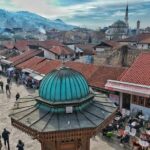
I especially like how the tour mixes iconic places with street-level photo moments, like the Sebilj area on Baščaršija Square (also nicknamed Pigeon Square). I also like that you’re not paying for attractions on top of the price, since the listed stops are admission ticket free, so your money goes to the photography guidance.
One possible drawback: the experience is weather-dependent. If conditions are poor, it can be rescheduled or refunded, so plan to keep your schedule flexible.
In This Review
- Key highlights you’ll feel on the walk
- Why Sarajevo is a perfect subject for street photography
- Getting oriented fast: start at Kovači 25, 10:00 am
- Sebilj Brunnen and Baščaršija: fountain, pigeons, and copper craft streets
- Sarajevo City Hall: Neo-Moorish details from the Austro-Hungarian era
- Latin Bridge: history you can photograph without turning it into a monument
- Gazi-Husrev Beg’s Bezistan: a covered bazaar for lines, light, and trade
- Gazi Husrev-Beg Mosque: Ottoman scale and Sarajevo’s main mosque
- Katedrala Srca Isusova: the cathedral that mixes influences into something local
- Sarajevo Meeting of Cultures: two different photos from one spot
- What you get for the price: paying for a pro eye, not just walking
- Who should book this and who might want another option
- A quick style note: how to get better photos on a tour like this
- Should you book InstaSarajevo for your Sarajevo trip?
- FAQ
- How long is the InstaSarajevo Photography Walking Tour of Sarajevo?
- How much does the tour cost?
- Where does the tour start and where does it end?
- What time does the tour start?
- Is the tour offered in English?
- Are entrance tickets included?
Key highlights you’ll feel on the walk
- Small group size (max 4) makes it easier to get photo guidance and keep moving at a human pace
- Pro photographer + street photography focus helps you go beyond snapshots
- Sebilj and Baščaršija give you fountain-and-street scenes in one tight stretch
- Ottoman, Austro-Hungarian, and modern-era Sarajevo all appear in one route
- Multiple photo perspectives in the same place, especially around the Meeting of Cultures area
- All stops are listed as admission ticket free, so you’re mostly paying for expertise, not entrances
Why Sarajevo is a perfect subject for street photography
Sarajevo works like a camera: it has contrasts you can’t fake. You get Ottoman domes and covered bazaars near Austro-Hungarian facades. You get stone streets where everyday life and big history share the same frame. And because the city center is walkable in a short time, you can keep your momentum without constantly checking schedules.
This is exactly the kind of setting where photography teaching makes sense. It’s not just about posing in front of a monument. It’s about learning how to notice light, people, textures, and architectural details while you’re moving.
You can also read our reviews of more walking tours in Sarajevo
Getting oriented fast: start at Kovači 25, 10:00 am
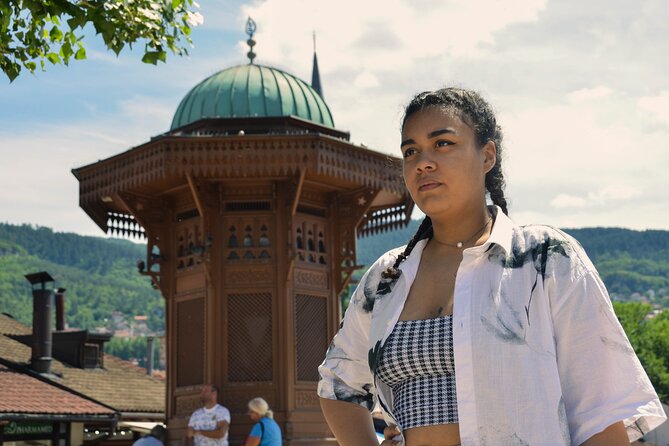
The tour starts at Kovači 25 in Sarajevo, beginning at 10:00 am and running about 2 to 3 hours. That timing is good for photography because you’re usually dealing with daylight that’s strong enough to show detail, but not always the harshest midday glare.
Also, this is set up for people who want structure without feeling boxed in. With a group capped at 4 travelers, you’re less likely to feel like you’re being rushed through a checklist. It’s also listed as offered in English, and you’ll receive a mobile ticket.
If you’re traveling solo and want something social but not crowded, this size matters. You’ll get the benefit of a pro’s eye without the chaos of a large group.
Sebilj Brunnen and Baščaršija: fountain, pigeons, and copper craft streets
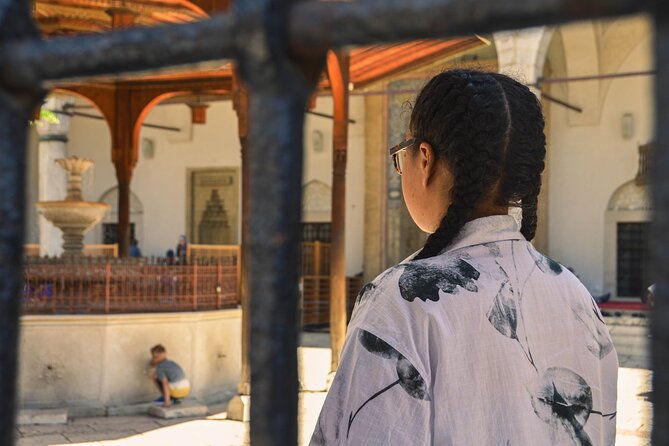
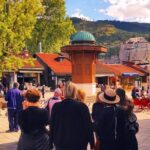
You start with Sebilj Brunnen on Baščaršija Square. Sarajevo used to have many sebiljs—kiosk-shaped public fountains—but today the one at Baščaršija is the last. That makes it more than a pretty spot. It’s a city symbol, and it’s also the kind of place where people gather. In this area, the square is often called Pigeon Square, which gives you a very Sarajevo-looking photo scene: the fountain as a focal point, and the surrounding bustle as context.
From there you head to Baščaršija, including Kazandžiluk, one of the oldest and most recognizable streets here. This street name comes from kazandžijas, master metalworkers and coppersmiths who originally produced kettles for the army and later made all kinds of copper vessels—pitchers, coffee pots, trays, and more. At Sarajevo’s Ottoman Golden Age, they were making around a hundred different kinds of items, which is the kind of detail that helps you photograph the street thoughtfully instead of treating it like a backdrop.
What makes this section work for photos:
- You get classic Sarajevo architecture and street life close together
- You can shoot wide views of the street, then switch to tighter frames of craft details
- The fountain-and-market contrast gives your photo set variety early
A small consideration: this is a walking tour with short stops (about 15 minutes each). If you want linger-and-stare photography, you’ll likely need to plan extra time on your own after the tour.
Sarajevo City Hall: Neo-Moorish details from the Austro-Hungarian era
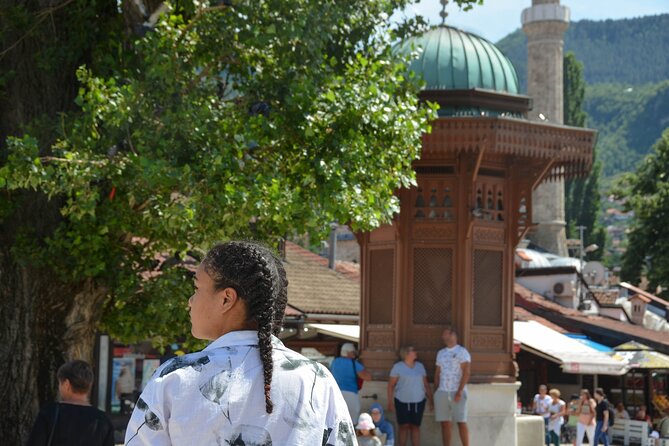
Next up is Sarajevo City Hall, described as the most representative Austro-Hungarian period building, completed in 1896. The architecture is labeled Neo-Moorish, with inspiration drawn from Islamic art in Spain and North Africa.
Even if you’re not an architecture nerd, this stop helps your photos because it offers geometric patterns, façade details, and a strong silhouette. This is one of those places where a pro photographer can help you get angles that show the style rather than just the front door.
Photo payoff here:
- Great for symmetry shots and vertical composition
- Useful for switching from street scenes to architectural close-ups
- Gives historical texture that connects the rest of the route
Latin Bridge: history you can photograph without turning it into a monument
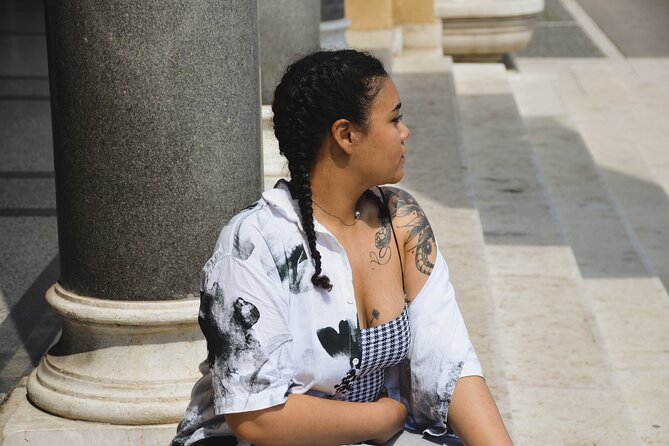
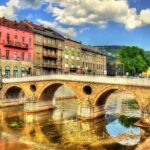
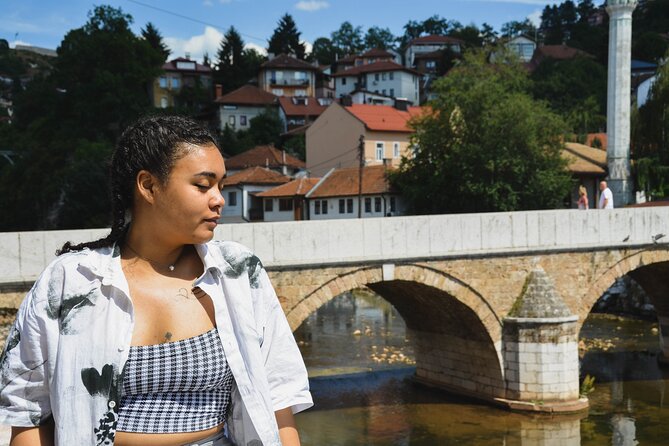
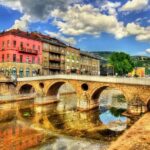
Then you reach the Latin Bridge, famous worldwide because it sits next to the assassination of Archduke Franz Ferdinand and Sophie. This stop is short, but it matters. The bridge isn’t only a landmark. It’s a reminder that Sarajevo has been pulled into European history again and again.
For photography, bridges are a gift. You can shoot from multiple sides, use the river direction for leading lines, and frame the space so the place tells the story without shouting it.
One practical tip: keep your camera ready but don’t ignore the setting. Even on a photography tour, a moment like this is worth a careful pause. You’ll get better frames because you’ll actually be paying attention to what’s around you.
You can also read our reviews of more photography tours in Sarajevo
Gazi-Husrev Beg’s Bezistan: a covered bazaar for lines, light, and trade
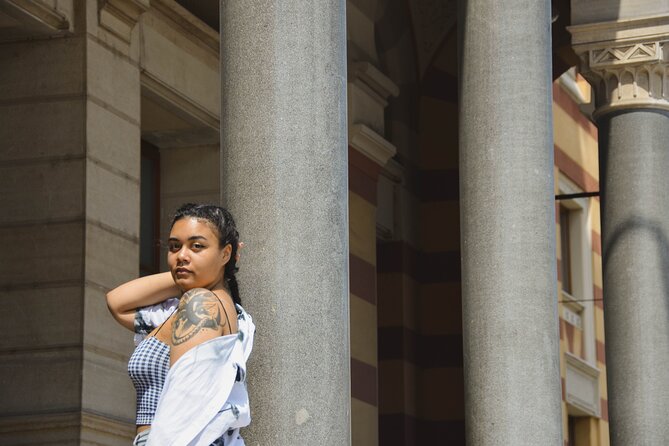
The tour then takes you to Gazi-Husrev Beg’s Bezistan, also called Old Bezistan or Great Bezistan. It’s part of Gazi Husrev Bey’s vakuf (endowment), and the structure is presumed to date back to around 1540.
A covered bazaar is a different photographic world. Outdoors, you chase light. Indoors, you learn to work with shadows, repeating shapes, and the way people move through a corridor-like space. Bezistan gives you that classic market architecture look: the ceiling framing, the rhythm of arches or openings, and the sense of passage.
What you’ll likely appreciate here:
- Architectural repetition that makes composition easier
- A shift from open squares to tighter, more intimate frames
- Strong texture for close-ups, especially if you’re shooting with a phone and want crisp detail
Gazi Husrev-Beg Mosque: Ottoman scale and Sarajevo’s main mosque
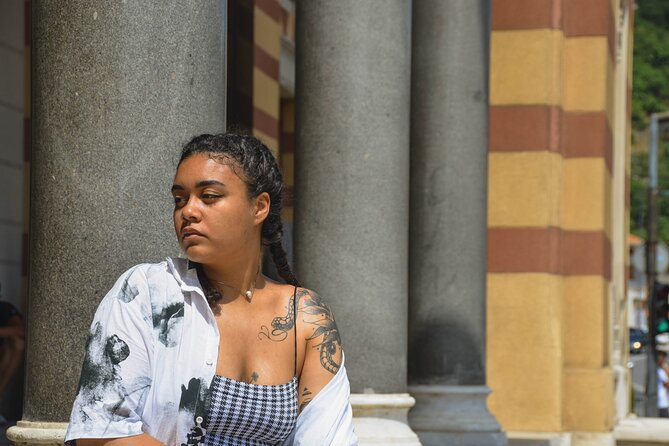
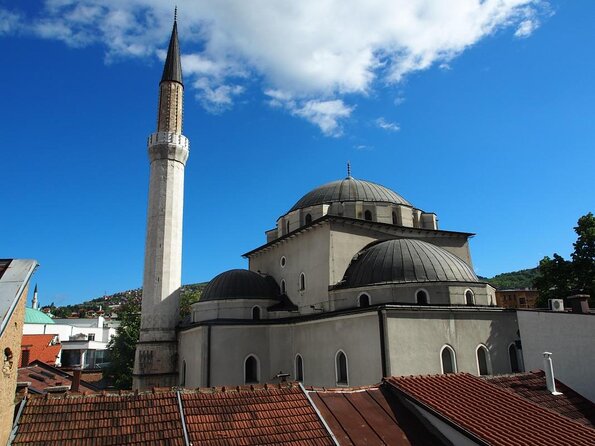
After the bazaar, you’ll see Gazi Husrev-beg Mosque, built in the 16th century. It’s described as the largest historical mosque in Bosnia and Herzegovina and one of the most representative Ottoman structures in the Balkans.
It also has an ongoing role. Since its construction, it has been the central Sarajevo mosque, and today it serves as the main congregational mosque for Muslims in Bosnia and Herzegovina.
For photos, this is where you slow down slightly (even if the stop is time-limited). Mosques reward careful framing: domes, minarets, courtyard edges, and the way the building sits in the street network.
A consideration to keep in mind: religious sites can be sensitive to timing and visitor behavior. Even on a photography-focused tour, be respectful with space, and keep your focus on the architecture and broader scene rather than forcing close-up shots that interfere with others.
Katedrala Srca Isusova: the cathedral that mixes influences into something local
Next comes Katedrala Srca Isusova (Sacred Heart Cathedral). The architect Josip Vancaš reportedly took inspiration from Notre Dame Cathedral in Dijon and St. Teyn Cathedral in Prague. The result, per the tour description, is a building that ended up authentically Sarajevo instead of copying those other cathedrals.
This stop is also framed with a visual bonus: it fits beautifully with the surroundings, with Gazi Husrev Bey’s Hamam (Turkish bath) visible in the background.
Why it helps your photos:
- You get a strong subject plus a second historic layer (the hamam)
- It’s a good place to shoot in context, not just as a single landmark
- The design contrast between cathedral and nearby Ottoman-era structures creates a natural story for your photo set
Sarajevo Meeting of Cultures: two different photos from one spot
The tour wraps with Sarajevo Meeting of Cultures, described as where East meets West. This is also presented as a spot where you can take two completely different photos from the same location.
That’s an important photography lesson, even if you don’t consider yourself a photographer: your viewpoint changes the story more than your subject does. If you’re using a phone, this is especially useful. Try shifting your angle a few steps left or right, change your height slightly, and look for what you include and what you cut out.
This final stop tends to feel satisfying because you’re not just collecting landmarks. You’re collecting variations—different ways to interpret the same city moment.
What you get for the price: paying for a pro eye, not just walking
At $34.92 per person, you’re not buying a long entrance pass. You’re buying time with a certified guide and professional photographer across multiple signature locations.
Here’s the value logic that makes sense:
- The itinerary’s stops are listed as admission ticket free, which means the cost mainly covers instruction and guidance
- The group limit of up to 4 supports real attention rather than a crowd flow
- You’re getting help that’s specifically about street photography and creating images you can actually use on your social profiles
One of the best points from feedback is that people felt they walked away with professional photos as part of the walk tour. That’s the difference between a normal walking tour and a photography tour. A guide can tell you what a place means. A photographer can help you capture it in a way that looks like you meant to take the picture.
Also, the tour is offered in English, and it’s set up so confirmation comes at booking. That’s helpful when you’re trying to plan Sarajevo days without extra back-and-forth.
Who should book this and who might want another option
This tour is a strong match if you:
- Want street photography guidance without spending hours figuring out settings and angles alone
- Prefer a small group setting (max 4) where you can ask quick questions
- Are the type who enjoys landmarks but also wants those everyday Sarajevo details around them
You might look for a different option if you:
- Need long free time at each stop to explore deeply on your own
- Travel with extremely tight timing and can’t handle weather changes, since the experience requires good weather
A quick style note: how to get better photos on a tour like this
Even though you’ll have a pro guiding the way, you’ll improve your results with a few simple habits:
- Bring a fully charged phone or camera and a way to keep it stable
- Wear comfortable shoes because you’re walking multiple historic areas in one morning
- If you’re focused on social-ready photos, think in sets: one wide, one medium, one detail shot per stop
The route is short enough that you can also plan to return later to the places you love most.
Should you book InstaSarajevo for your Sarajevo trip?
Yes, I think you should book it if your goal is photos with a story. The mix of Sebilj, Baščaršija craft streets, Austro-Hungarian architecture, Ottoman landmarks, and a cultural photo finale makes it a good one-session plan for Sarajevo.
The best reason to choose it: you’re not just getting explanations. You’re getting professional photography help from a small-team setup. For solo travelers especially, it’s a practical way to turn a morning walk into a set of images you’ll actually want to post.
If the weather is questionable, keep an eye on your day and be ready to adjust. Otherwise, this is a smart value: you pay for a pro eye, and the landmark sites themselves are already built into the route.
FAQ
How long is the InstaSarajevo Photography Walking Tour of Sarajevo?
It lasts about 2 to 3 hours.
How much does the tour cost?
The price is $34.92 per person.
Where does the tour start and where does it end?
The tour starts at Kovači 25, Sarajevo 71000, Bosnia and Herzegovina and ends back at the meeting point.
What time does the tour start?
The start time is 10:00 am.
Is the tour offered in English?
Yes, it’s offered in English.
Are entrance tickets included?
Tickets and entrances are listed as not included, but the tour’s listed stops show admission ticket free.
You Might Also Enjoy
More Walking Tours in Sarajevo
More Tours in Sarajevo
- Fall of Yugoslavia, Sarajevo War Tour with Tunnel of Hope Museum and Frontlines
★ 5.0 · 1,314 reviews

More Tour Reviews in Sarajevo
- Fall of Yugoslavia, Sarajevo War Tour with Tunnel of Hope Museum and Frontlines
★ 5.0 · 1,314 reviews