REVIEW · SARAJEVO
Sarajevo Grand Walking Tour
Book on Viator →Operated by Insider Ltd · Bookable on Viator
Sarajevo packs centuries into a single walk. This 3-hour Grand Walking Tour strings together major landmarks and the stories behind them, from the moment that helped trigger World War I to Ottoman streets and modern memorials.
What I like most: you get full narration (not just photo stops), and the route hits both religious landmarks and public-life spots like markets and historic streets.
One thing to keep in mind: this is a set route with lots of short stops, so it can feel history-heavy if you prefer a slower, more tailored pace.
In This Review
- Quick hits before you step out
- What your $20.57 mainly buys: a guided story on foot
- Latin Bridge: the moment the world changed
- Mejdan Park and the Miljacka River: the city breathes here
- Emperor’s Mosque and the Franciscan Church of Saint Anthony: faith side by side
- Sarajevo Brewery and the modernist Bosnian House: industry + architecture
- The Spite House: a tiny building with an attitude
- City Hall’s neo-Moorish look: East and West in one façade
- Kovači Cemetery and Eternal Flame: remembrance you can’t scroll past
- Old Ottoman streets: Kovači Street, Baščaršija, and the Sebilj fountain
- Morica Han and Gazi Husrev-beg Mosque: Ottoman hospitality and 16th-century faith
- Sarajevo Meeting of Cultures, plus Jewish and Christian landmarks
- Markale City Market: local flavors at human speed
- Who this tour suits best
- Price and Logistics: a short tour with a lot of stops
- Final verdict: should you book Sarajevo Grand Walking Tour?
- FAQ
- How long is the Sarajevo Grand Walking Tour?
- What does the Sarajevo Grand Walking Tour cost?
- Is the tour offered in English?
- What is included in the tour price?
- Is lunch or coffee included?
- Is there a mobile ticket?
- Where does the tour start and end?
- What’s the cancellation and weather policy?
Quick hits before you step out
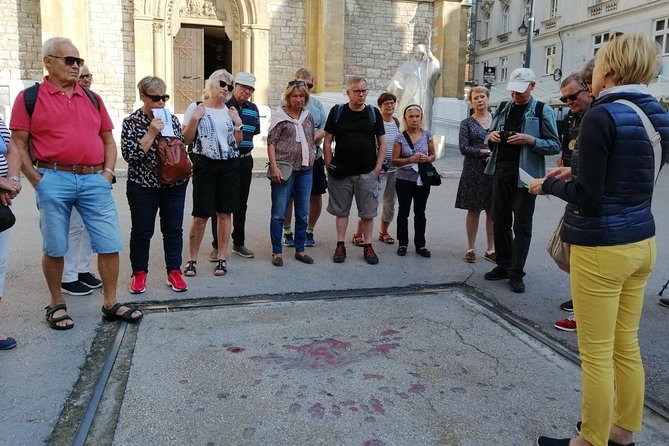
- Latin Bridge to Baščaršija in one route: you’ll see the big “how did Sarajevo become Sarajevo?” landmarks without switching tours.
- Free-entry stops built into the walk: many listed sights don’t require tickets, so your money goes mainly to the guide.
- A guide who can handle complicated timelines: expect the Ottoman, Austria-Hungary, Yugoslavia, and 1990s context to connect.
- Religious Sarajevo, all in one loop: mosques, a Franciscan church, Catholic cathedral, Orthodox cathedral, plus the Jewish Museum.
- Public memory in open air: Kovači Cemetery and the Eternal Flame add weight without turning this into a museum day.
- Easy “street level” Sarajevo: markets, a fountain, an Ottoman inn, and neighborhood lanes keep it grounded.
What your $20.57 mainly buys: a guided story on foot
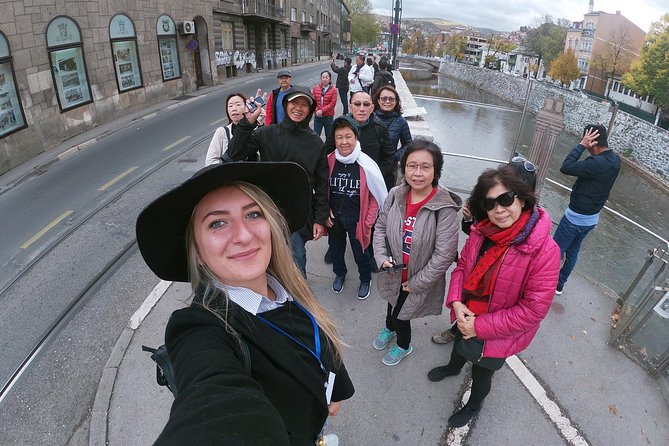
This tour runs about 3 hours and costs $20.57 per person. The value stands out because the tour includes a guide and a city map, and many stops are listed as admission free. In practice, that means you’re paying for context and pacing, not entry fees and paperwork.
Group size is capped at 30 travelers, which usually helps with question-and-answer time. It’s also offered in English, and the activity uses a mobile ticket, so you’re not hunting for paper confirmations.
If you’re the type who likes to look up at domes, clock towers, and church spires while also understanding why they’re there, this tour fits your style. If you want time to wander independently for long stretches, you’ll likely need to add a bit of your own exploring afterward.
You can also read our reviews of more walking tours in Sarajevo
Latin Bridge: the moment the world changed
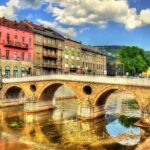
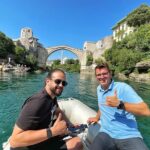
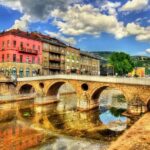
The walk begins at Latin Bridge, tied to the assassination of Franz Ferdinand. This is the spot where one gunshot is described as a spark that helped ignite World War I. Even if you know the headline-level story, I like starting here because it makes the rest of Sarajevo’s layers easier to understand.
What to do here: don’t rush the viewpoint. Spend a few minutes letting the guide connect “local event” to “global consequences.” This is where the tour’s tone starts—Sarajevo isn’t presented as a postcard city; it’s presented as a crossroads where history keeps leaving marks.
Because the listed stop notes free admission, you’re not losing time to ticketing. You’re just absorbing.
Mejdan Park and the Miljacka River: the city breathes here
Right after the heavy historical anchor, you get a quick reset at Mejdan Park along the Miljacka River. It’s a short stop, but it matters. Sarajevo’s identity isn’t only trauma and politics. It also includes everyday spaces where people slow down.
Use this moment to observe how the city sits alongside water and greenery. It also helps you switch gears after Latin Bridge—your brain has a place to unclench.
Emperor’s Mosque and the Franciscan Church of Saint Anthony: faith side by side
Next up, the tour moves through Emperor’s Mosque, described as Sarajevo’s oldest mosque and an emblem of Islamic heritage. A visit here is quick, but the narration is where this stop becomes useful. You’re not just looking at architecture—you’re learning how Sarajevo’s centuries of rule and culture show up in religious life.
Then the route heads to the Franciscan Church of Saint Anthony, a neo-Gothic church and a signal of Sarajevo’s spiritual diversity. The clever part of the tour is the contrast: mosque, then Catholic church, without treating them as separate “topics.” Sarajevo’s guide-by-story approach nudges you to see them as neighbors shaped by the same city.
Practical tip: if you’re sensitive to kneeling/standing expectations inside churches or mosques, follow what staff or the guide suggests. This tour is designed for viewing and understanding, not for ignoring local customs.
Sarajevo Brewery and the modernist Bosnian House: industry + architecture
A couple of the stops tilt away from monuments and into everyday infrastructure.
At Sarajevska Pivara (Sarajevo Brewery), you’ll hear about Bosnia’s oldest industrial complex and the tradition behind beer production. It’s a reminder that cities aren’t only defined by rulers and wars. Industry and craft matter too, and Sarajevo has its own story of that.
Later comes the Bosnian House Bicakcic-Hadzisabanovic, described as a modernist architectural gem. Modernism can feel abstract in other cities, but here it’s placed along a route of older layers, so you start noticing how Sarajevo evolved rather than staying stuck in one era.
If architecture is your thing, these two stops are a welcome change of pace. They make the tour feel like a city tour, not just a history lecture on sidewalks.
- Fall of Yugoslavia, Sarajevo War Tour with Tunnel of Hope Museum and Frontlines
★ 5.0 · 1,314 reviews
The Spite House: a tiny building with an attitude
Then you hit the Spite House (House of Spite). This is one of those Sarajevo landmarks where the story gives the building its personality. It’s described as Sarajevo’s most defiant house, rebuilt brick by brick—the kind of local detail that history books often skip.
This stop works because it’s small-scale conflict. You get a feel for how individuals fought for space and principles long before governments got involved in the biggest headlines.
If you like stories you can retell over dinner later, this is the kind of stop that makes that happen.
City Hall’s neo-Moorish look: East and West in one façade
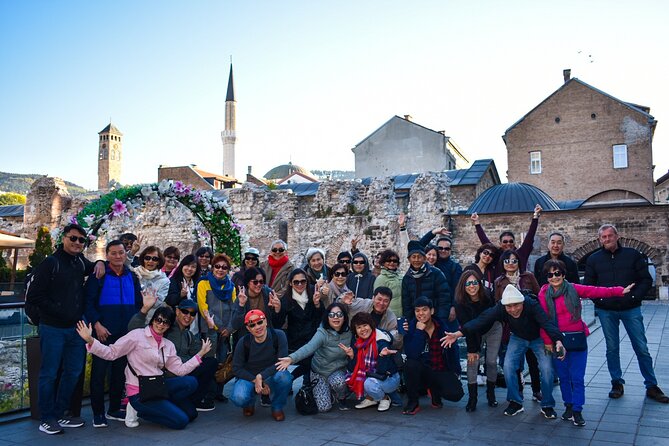
At Sarajevo City Hall, you’ll see a neo-Moorish masterpiece designed to blend East and West. This is architecture used as message. The tour doesn’t treat it like decoration; it treats it like a cultural statement.
Take a moment to compare the vibe here with the religious stops earlier. City Hall sits in the “public power” category, while mosques and churches sit in “spiritual life.” Seeing them in sequence helps you map how different institutions tried to represent identity across different periods.
Kovači Cemetery and Eternal Flame: remembrance you can’t scroll past
History turns solemn in two separate stops.
At Kovači Cemetery, the tour points you to a national memorial honoring Bosnia’s defenders from the 1992–1995 war. Then, later, you’ll stand at the Eternal Flame, described as a World War II monument and a symbol of resilience and remembrance.
I appreciate that the tour handles remembrance in open spaces rather than only in indoor exhibits. You’re not just learning facts—you’re learning how Sarajevo marks loss in daily geography.
Tip for your visit: bring a calm mindset. These stops are short, but they carry emotional weight. If you talk during these moments, keep it respectful.
Old Ottoman streets: Kovači Street, Baščaršija, and the Sebilj fountain
The route keeps moving through the Old Town character of Sarajevo.
On Kovači Street, you’ll notice Ottoman-era charm and local shops. It’s not a staged square; it feels like a working street where locals still pass through.
Then comes Baščaršija, the old-town marketplace. This is the city’s heart in a practical sense: food, crafts, small errands, and everyday conversation. It’s also a place where your guide’s job matters, because a market can be overwhelming without a trail of what to look for.
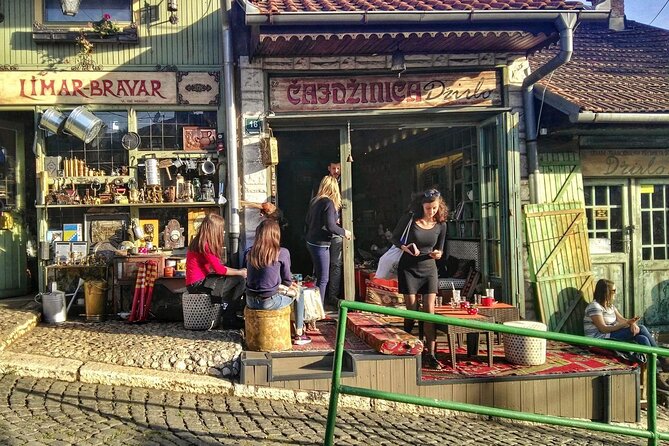
Near there are Bravadžiluk and Kazandžiluk Streets, tied to traditional metalwork and culinary delights on ancient lanes. If you like crafts, you’ll probably enjoy watching how these streets specialize. If you don’t plan to buy anything, it still helps to understand why the shops are clustered the way they are.
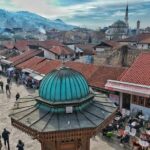
Then you’ll reach Sebilj (Sebilj Brunnen) Fountain. The stop includes the legend of returning to Sarajevo, which is the kind of local myth that turns a simple landmark into a personal memory for you.
Morica Han and Gazi Husrev-beg Mosque: Ottoman hospitality and 16th-century faith
At Morica Han, you step into what’s described as Sarajevo’s last Ottoman inn—an architectural reminder of hospitality as a city function. An inn isn’t just a building; it’s a system built for travelers, trade, and news traveling along the same routes as merchants.
Next is Gazi Husrev-beg Mosque, described as a 16th-century spiritual masterpiece and a beacon of serenity and faith. The stop lasts longer than some others (around 10 minutes), which signals that the guide wants you to take your time with this one.
If you want a quick rule for spotting why this tour feels “connected,” it’s this: you’re seeing how Sarajevo’s Ottoman identity isn’t only in history books. It shows up in hospitality spaces (Morica Han) and in religious landmarks (Gazi Husrev-beg Mosque) right next to the modern-day city.
Sarajevo Meeting of Cultures, plus Jewish and Christian landmarks
At Sarajevo Meeting of Cultures, you stand at a symbolic crossroads of East and West, where cultures merge. This stop is short, but it’s a useful lens for the rest of what you’ll see.
Then the tour moves into minority-history landmarks in a direct way:
- Museum of the Jews of Bosnia and Herzegovina (Old Jewish Temple): tied to Sephardic Jewish heritage and the Sarajevo Haggadah.
- Cathedral of Sacred Jesus Heart (often compared to Sarajevo’s Notre Dame): the tour frames it as a grand Catholic landmark.
- Serbian Orthodox Cathedral: described as magnificent, with murals and domes.
One reason this section works is pacing. You’re not bouncing between “random famous buildings.” You’re walking a chain that supports the tour’s big idea: Sarajevo’s culture is layered, and different communities have shaped it over time.
If you’re worried about getting overwhelmed by names and dates, focus on one thing per stop. For example: in the Jewish museum, track the artifact-level importance; in the cathedral and Orthodox church, track the visual design and how it signals identity.
Markale City Market: local flavors at human speed
At Markale City Market, the tour gives you a quick look at Sarajevo’s market life—local flavors and the feel of commerce in motion. This is where the tour becomes practical in a different way. After walking through history, you finally see what a city tastes like now.
Since lunch and coffee are not included, you can treat this market stop as a cue to plan your next meal. Even if you don’t buy anything during the tour, you’ll come away with a smarter sense of where to eat later.
Who this tour suits best
This is ideal for you if:
- you want a first-day orientation through Sarajevo’s core districts
- you like history told through street-level places, not only museums
- you want to understand how multiple communities coexist in the same city fabric
- you prefer a guided route that helps you ask questions and connect timelines
It may not be ideal if:
- you want long free time to wander without a structured narrative
- you’re not interested in the heavier parts of Sarajevo’s history (Kovači Cemetery and WWII remembrance are part of the route)
- you want a highly custom itinerary (the tour is built around fixed stops, even though you can ask questions)
Price and Logistics: a short tour with a lot of stops
Let’s talk practical value. At $20.57, you’re paying for about three hours of guided walking that includes a large number of landmark categories: WWI context, Ottoman architecture, public buildings, religious sites across faiths, Jewish heritage, and memorials.
The route includes free-admission at the listed stops, so your overall costs beyond the tour are mostly what you choose to spend on food. Since lunch and coffee/tea aren’t included, plan to grab something after the tour—or bring a snack if you’re the kind of person who gets hungry during long walks.
Departure options are available, and there’s an option to upgrade to a private tour if you want more attention and less group pacing.
Final verdict: should you book Sarajevo Grand Walking Tour?
I think you should book this tour if you want the fastest way to understand how Sarajevo’s identity hangs together across centuries. It’s a focused route that gives you the “why” behind the big sights, and it also includes everyday Sarajevo moments like markets and traditional street lanes.
If you’re unsure, use this test: if you can’t decide between historical landmarks and food-and-street time, this tour is built for the compromise. Pick it early in your stay, bring a few questions about what you’re seeing, and you’ll leave with a map in your pocket and a clearer mental map of the city in your head.
FAQ
How long is the Sarajevo Grand Walking Tour?
The tour lasts about 3 hours.
What does the Sarajevo Grand Walking Tour cost?
The price is $20.57 per person.
Is the tour offered in English?
Yes, the tour is offered in English.
What is included in the tour price?
The tour includes a guide and a city map.
Is lunch or coffee included?
No. Lunch and coffee and/or tea are not included.
Is there a mobile ticket?
Yes, the tour uses a mobile ticket.
Where does the tour start and end?
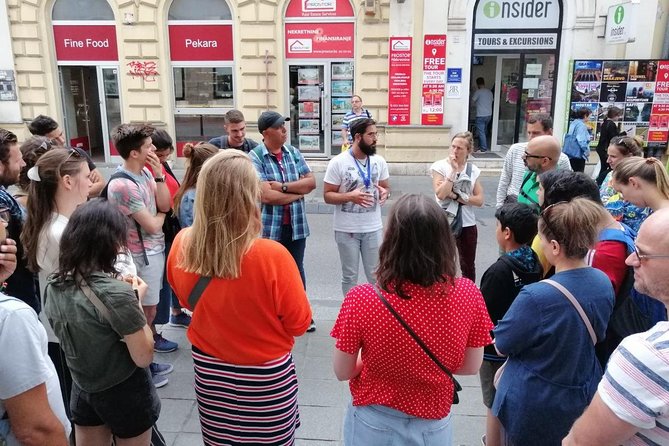
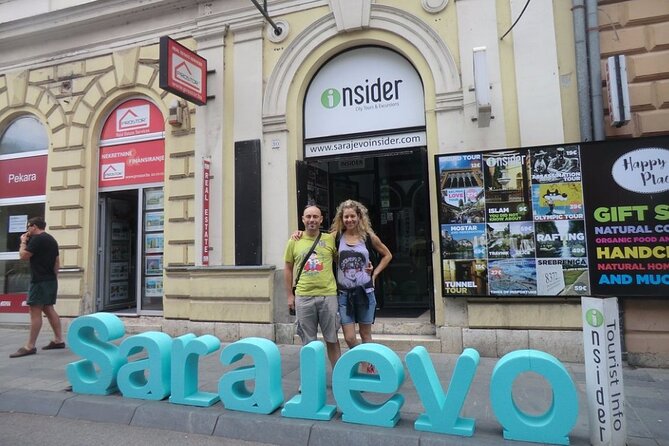
The meeting point is Sarajevo Insider – City Tours and Excursions, Zelenih beretki 30, Sarajevo 71000, Bosnia and Herzegovina. The tour ends back at the meeting point.
What’s the cancellation and weather policy?
You can cancel for free up to 24 hours in advance for a full refund. If the tour is canceled due to poor weather, you’ll be offered a different date or a full refund. If it’s canceled because the minimum number of travelers isn’t met, you’ll be offered a different experience/date or a full refund.
You Might Also Enjoy

More Walking Tours in Sarajevo

More Tours in Sarajevo
- Fall of Yugoslavia, Sarajevo War Tour with Tunnel of Hope Museum and Frontlines
★ 5.0 · 1,314 reviews

More Tour Reviews in Sarajevo
- Fall of Yugoslavia, Sarajevo War Tour with Tunnel of Hope Museum and Frontlines
★ 5.0 · 1,314 reviews