REVIEW · SARAJEVO
Walking Tour in Sarajevo
Book on Viator →Operated by The Globe Balkans · Bookable on Viator
Sarajevo is one of those cities where history is on every corner. This walking tour strings together Ottoman and Austro-Hungarian architecture with lively, personal storytelling from guide Suvad, so you don’t just see sights—you understand why they matter. You’ll also catch the sounds and smells that make Sarajevo feel like Sarajevo: church bells, calls from minarets, cevapi, pita, and Turkish coffee.
The main thing to consider is that some of the stops involve admission tickets not included, so your total cost can be a bit higher if you want to go inside everything. Also, it’s a weather-dependent, walking-focused tour, so plan for comfortable shoes and a little flexibility.
In This Review
- Key things I’d prioritize
- Why Sarajevo feels different on foot
- The practical run: starting at Telali 19, finishing near Multicultural Man
- City Hall, the cevapi-and-pita street, and Kazandžiluk’s craft stories
- Timing note
- Sebilj’s Wooden Fountain and Morića Han as a caravan crossroads
- Practical consideration
- Gazi Husrev-beg Mosque and Bezistan: the 16th-century core
- Tickets note
- Sarajevo Meeting of Cultures: the Istanbul-in-small meets Vienna-in-small idea
- The 1914 turning point at Muzej Sarajeva
- Tickets note
- Jewish Museum stop: Sephardic synagogue history and memorial themes
- Practical note
- Two cathedrals, one square, and Sarajevo’s “multicultural” center moments
- Food, coffee, and the soundscape that makes the tour feel real
- Price and value: $69.46 per group up to 4
- How to plan your Sarajevo day for this walk
- Should you book this Sarajevo walking tour?
- FAQ
- How long is the Sarajevo walking tour?
- How much does it cost?
- Is pickup included?
- Do I need tickets for the stops?
- Where does the tour start and end?
- Is this a private tour?
- What should I bring for the best experience?
- Is there a cancellation option if plans change?
Key things I’d prioritize
- Ottoman-to-Vienna-in-small story line at places like the Sarajevo Meeting of Cultures
- Food-scent stops built into the walk (cevapi, pita, Turkish coffee)
- 16th-century landmarks like Gazi Husrev-beg Mosque and Bezistan bazaar
- A living bazaar feel at Kazandžiluk, plus craft talk with shop vendors
- Major 1914 context around the Franz Ferdinand assassination site
- Two church traditions plus a shared square vibe, including chess in the square
Why Sarajevo feels different on foot
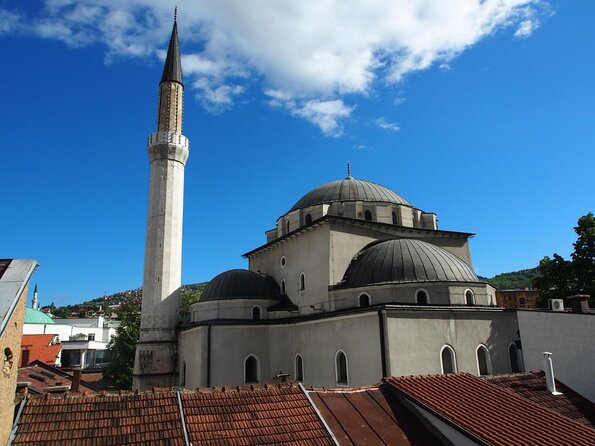
If you’re trying to understand Sarajevo quickly, walking is the smart move. The city doesn’t present history in neat, separate boxes. You get Ottoman-era shapes right next to Austro-Hungarian-era details, and the tour helps you connect the dots as you go.
What I like most is that the route is designed around contrasts, not just checkpoints. You get the Ottoman thread through the mosque courtyard, the old bazaar style, and the craft-and-coffee stories. Then you hit Austro-Hungarian markers and the shock of 1914, where everything shifts into modern European history. The guide’s approach—focused, factual, and willing to answer even the awkward questions—keeps it from turning into a lecture.
You’ll also notice that sensory cues are part of the experience. The tour builds time near the kinds of spots where you can smell cevapi and pita, and where the aroma of Turkish coffee hangs around the street. Church bells and minaret calls don’t show up on cue like a movie soundtrack, but on the ground, they do make the city feel layered.
You can also read our reviews of more walking tours in Sarajevo
The practical run: starting at Telali 19, finishing near Multicultural Man
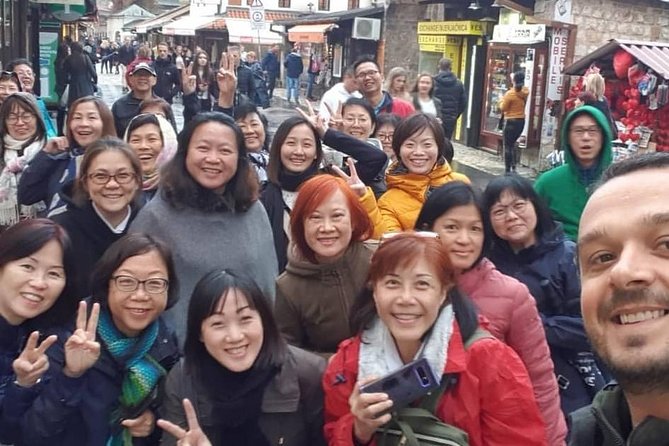
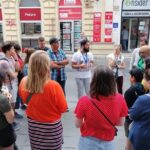
This is a small-group private experience, priced per group up to 4. That matters because you’re not stuck with a big crowd. You can ask questions, and the guide can adapt the pace to your interests—something I think makes a big difference in a city like Sarajevo, where one street can connect multiple eras.
You start at Telali 19 in Sarajevo at 9:00 am, and you end at the Orthodox Church of the Nativity of the Theotokos, at the square next to the Multicultural man monument. The duration is listed as 1 to 3 hours, so think of it as a short-to-medium walk with stops, not a full-day city tour.
Pickup is offered, and you also get an air-conditioned vehicle with WiFi on board. Even if the focus is walking, this is a nice comfort backup—especially if your day includes heat, crowds, or you want a quick reset during transfers.
City Hall, the cevapi-and-pita street, and Kazandžiluk’s craft stories
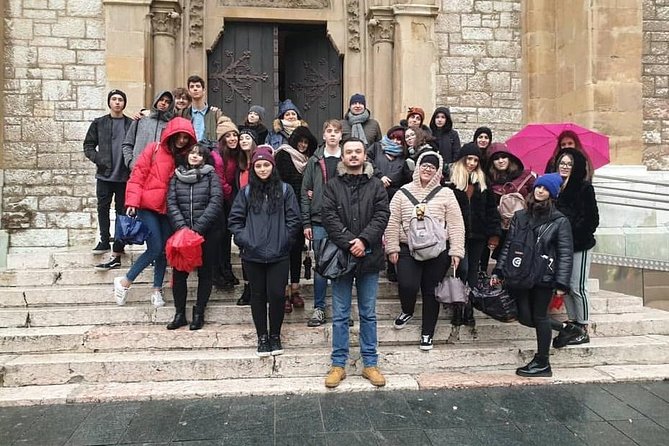
The first stretch sets the tone: official buildings, everyday food, and the old commercial spine of the city.
At Sarajevo City Hall, you spend time on the building’s story: construction, how it was used, and its destruction and reconstruction. Even if you’re not a history buff, this stop helps you understand that Sarajevo’s architecture isn’t frozen in time. It’s been reshaped by major events, then rebuilt to keep functioning.
Next comes the street where you can eat some of the best cevapi and pita in Sarajevo, with the chance to see how it’s made. This is more than a snack break. It’s how you learn what daily life feels like here. When you pair food with architecture, the city stops feeling like a museum and starts feeling like a place people actually live.
Then you move into Kazandžiluk, one of those streets that feels made for conversation. The focus is vendor life and craft traditions, with stories tied to coffee tasting and making, pot making and decoration, and general Ottoman-period life in Sarajevo. You’re not just looking at storefronts—you’re hearing how people worked, sold, and built their identity through everyday objects.
Timing note
Some stops are short by design, like quick photo-and-explain moments. If you like slow travel, you’ll get more out of this by asking the guide to point out what to notice before you move on.
Sebilj’s Wooden Fountain and Morića Han as a caravan crossroads
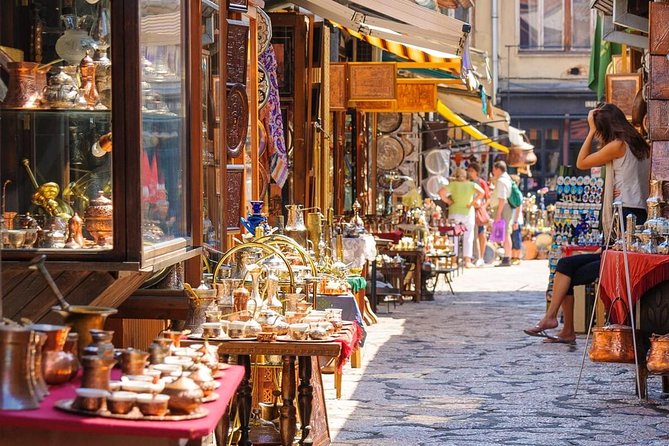
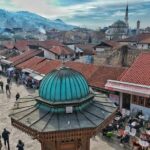
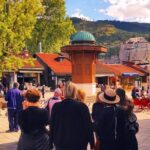
A highlight for many first-timers is Sebilj, the wooden fountain. Here, the guide talks about its history, creation, and how it was used across centuries. It’s one of those Sarajevo fixtures you’ll see again later in your own wandering, so learning its story early helps you “read” the city as you go.
From there, you go to Morića Han, which was once a caravan saray—a stopping point for travelers and trade. This matters because it connects Sarajevo’s old role in movement and exchange, not just local life. You get a sense of how goods and ideas moved through the region.
You’ll also have a chance to see a carpet store with traditional Bosnian carpets. This is a good moment to slow down and look at texture and pattern rather than rushing to photos. If you’re shopping later, your eyes will be better trained.
- Fall of Yugoslavia, Sarajevo War Tour with Tunnel of Hope Museum and Frontlines
★ 5.0 · 1,314 reviews
Practical consideration
This is a walking tour with focused stops, so if you want long shopping sessions inside every shop, you’ll likely need to add extra time on your own.
Gazi Husrev-beg Mosque and Bezistan: the 16th-century core
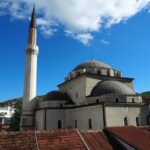
The tour spends real time in the courtyard of the Gazi Husrev-beg Mosque. The guide covers construction and usage, and also connects the mosque complex to the wider neighborhood built around it in the 16th century. That’s useful because it explains the mosque not as a standalone landmark, but as part of a community system.
The talk includes references to the Medressah (Islamic school), public toilets, a library, and the surrounding neighborhood construction tied to the mosque. You get a fuller picture of what “religion” meant here—education, services, and daily structure—not just worship.
Then you pass into Gazi-Husrev Beg’s Bezistan, described as a closed bazaar created as a copy of Kapalı Çarşı in Istanbul. The building itself is the focus: a 16th-century structure that feels like you’ve stepped into a different kind of time and weather. Even if you don’t buy anything, it’s a strong place to slow down and understand how trade worked under one roof.
Tickets note
Admission is listed as not included for some stops, including the mosque-related entry information. If you want to go inside where tickets apply, budget for that and don’t assume every interior is free.
Sarajevo Meeting of Cultures: the Istanbul-in-small meets Vienna-in-small idea
This stop is short, but it’s one of the most important concepts in the whole route.
At the Sarajevo Meeting of Culture spot, you’re pointed toward the idea that East meets West right in this city. It’s the tour’s way of making the contrasts feel real, not abstract. The guide’s framing helps you notice how you can walk a few minutes and feel like you’ve shifted architectural languages.
If you want to understand Sarajevo fast, don’t skip the “explain this location” moments. This is one of them.
The 1914 turning point at Muzej Sarajeva
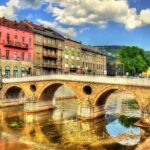
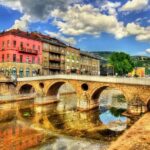
No Sarajevo tour that touches the center of the city can ignore 1914, and this one hits it at Muzej Sarajeva area, connected to the assassination of Austro-Hungarian Archduke Franz Ferdinand in 1914.
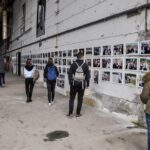
The guide points out the photographs of assassin Gavrilo Princip and talks about the reasons to start World War I—as explained during the stop. Even though this is a brief moment on the route, it’s effective because it places the event inside the urban geography. You’re not reading about it in a book far away. You’re standing where the shock of history played out.
Tickets note
Admission is not included at this stop, so if you want museum time, you’ll likely need to plan it separately or add funds for entry.
Jewish Museum stop: Sephardic synagogue history and memorial themes
You also stop in front of what was once a Sephardic Synagogue, now tied to the Jewish Museum of Bosnia and Herzegovina. The guide focuses on history of Jewish people in the country and mentions the Haggadah (including an illuminated manuscript), plus Holocaust remembrance and Righteous among Nations.
This part works best if you’re emotionally ready for serious topics. It’s not heavy-handed, but it’s clear-eyed. You come away with a better sense that Sarajevo’s story is not only about empires and wars—it’s also about communities and survival.
Practical note
Admission is not included here as well, so decide ahead of time whether you want to go inside for deeper museum content.
Two cathedrals, one square, and Sarajevo’s “multicultural” center moments
The tour doesn’t leave Christianity out of the picture.
First is Katedrala Srca Isusova (Cathedral of the Sacred Heart of Jesus). You’ll visit and hear about its neogothic construction and the fact that the Pope visited in 1997 and 2015. That gives you a modern anchor, not just an old-building anchor.
Then you stop at the Serbian Orthodox Cathedral area to talk about its lavish architectural style and Serbian community presence. The route makes you compare how different Christian traditions express themselves in space.
You’ll also spend time around a square where chess is being played with big figures, and talk about the monument in the centre called Multicultural Man. This is where the city’s identity feels playful and serious at the same time—an open public space for daily life and symbols for Sarajevo’s story.
Food, coffee, and the soundscape that makes the tour feel real
This is one of those experiences where the food isn’t an afterthought. The walk is built around the sensory stuff you can only get in the moment: smell of čevapi, the aroma of different pies, the pull of Turkish coffee, and the way bells and minarets layer over the streets.
What I like about this approach is that it doesn’t force a formal meal. You get short, purposeful moments that help you understand the rhythm of daily life. Even if you’re not eating at every stop, you’ll learn where the city naturally gathers and how people move through food streets.
Price and value: $69.46 per group up to 4
The price is listed as $69.46 per group (up to 4). That’s often where the value equation changes, because with small private tours you’re paying for guide time and a more personal pace.
If you split the cost among friends, it can work out very reasonably for a 1–3 hour tour that covers a lot of distinct cultural zones. You also get pickup offered, WiFi on board, and an air-conditioned vehicle, which adds comfort you wouldn’t always expect on a walking-focused experience.
The main value caveat is the admission situation: several stops list tickets as not included. That means your headline price can rise depending on what you choose to enter. If your priority is just exterior architecture and guided storytelling, you can keep costs closer to the base price.
How to plan your Sarajevo day for this walk
A few practical tips help you get more out of it:
- Wear good walking shoes. The tour is short enough to finish in one outing, but it still involves movement between key neighborhoods.
- Bring a light layer. Sarajevo weather can shift, and this experience requires good weather.
- Decide early about museum and church interiors. Some stops are ticketed; others are free to experience from the outside or around the area.
- Use the guide for orientation. This is the kind of tour where the best payoff comes when you ask what to notice next as you move through each area.
If you’re short on time and want a fast education in Ottoman and Austro-Hungarian Sarajevo, this walk gives you a strong base line. Then you can return later to the places that caught your attention.
Should you book this Sarajevo walking tour?
Book it if you want a small private way to connect Sarajevo’s architecture, daily life, and major historical moments without wasting half your day figuring out logistics. The strongest reason to choose it is the guide’s style: clear, story-driven, and willing to answer questions—especially if you like personal context alongside facts.
Skip it or rethink your expectations if you’re mainly after long museum visits or you want a tour where every interior is included at no extra cost. With several stops listing admission not included, you’ll likely need to budget a bit more if you want to go fully inside.
FAQ
How long is the Sarajevo walking tour?
The duration is listed as about 1 to 3 hours, depending on pace and how long you spend at each stop.
How much does it cost?
It’s priced at $69.46 per group, for groups up to 4.
Is pickup included?
Pickup is offered, and the tour also includes an air-conditioned vehicle and WiFi on board.
Do I need tickets for the stops?
Some stops list admission tickets not included (like City Hall, the mosque-related stop, Muzej Sarajeva, and the Jewish museum area). Other stops are listed as free.
Where does the tour start and end?
It starts at Telali 19, Sarajevo at 9:00 am and ends at the Orthodox Church of the Nativity of the Theotokos area, at the square next to the Multicultural man monument.
Is this a private tour?
Yes. It’s described as private, meaning only your group participates.
What should I bring for the best experience?
Comfortable shoes are a must since it’s a walking tour. Since it requires good weather, plan for outdoor time and bring what you’d normally need for walking in town.
Is there a cancellation option if plans change?
The experience offers free cancellation if you cancel up to 24 hours in advance for a full refund, based on local time.
You Might Also Enjoy

More Walking Tours in Sarajevo
More Tours in Sarajevo
- Fall of Yugoslavia, Sarajevo War Tour with Tunnel of Hope Museum and Frontlines
★ 5.0 · 1,314 reviews

More Tour Reviews in Sarajevo
- Fall of Yugoslavia, Sarajevo War Tour with Tunnel of Hope Museum and Frontlines
★ 5.0 · 1,314 reviews