REVIEW · SARAJEVO
PROFESSIONAL SARAJEVO WALKING TOUR – With guide who guided STING!
Book on Viator →Operated by Art and Tours Sarajevo · Bookable on Viator
Sarajevo history walks right beside you. This Professional Sarajevo Walking Tour in English strings together the city’s best-known sights in about 2 to 3 hours, with a guide named Mak who (as the operator advertises) has guided Sting. You’ll move at a steady walking pace and pick up how Sarajevo’s identity was shaped by many layers of faith, empire, and conflict.
Two things I really like: first, you get a tight loop of landmarks with cultural and historical storytelling rather than just photo stops. Second, Mak’s explanations are clear and he checks in with the group so adults and teenagers stay on the same page. A family of four did the tour with Mak, and the guide was patient and helpful when questions came up, even with a dog tagging along.
One possible drawback: you cover a lot of ground in a short window, so if you love lingering at one place (instead of hopping to the next), plan to return later on your own.
In This Review
- Fast reasons this Sarajevo walk works
- Why this Sarajevo walking tour hits the right pace
- Meeting at Đulagina 2 at 6:15 pm: practical logistics that reduce stress
- Stop-by-stop: Sarajevo’s famous landmarks, in the order that makes sense
- Sacred Heart of Jesus Cathedral and the Roses of Sarajevo trail
- Serbian Orthodox Church of the Nativity of the Theotokos, plus park time and a sculpture
- Ferhadija Pedestrian Street: the Eternal Flame and Tito street
- Gazi Husrev-Beg Medresa: mosque, bazaar lanes, a clock tower, and Jewel street
- Princip Gavrilo, Latin Bridge, and the WWI story that’s tied to the street
- Mausoleum of Princip Gavrilo and the assassination spot area
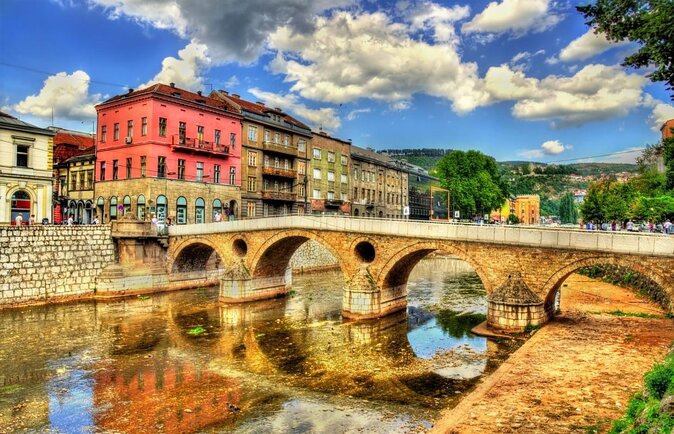
- Latin Bridge: Franz Ferdinand and Sophie, WWI
- City Hall, Inat Kuća, fortresses, and the Olympic mountain viewpoints
- Sarajevo City Hall and what’s around it
- Yellow Fortress and Kovaci street plus Food street
- Sebilj Brunnen and Pigeon Square: Sarajevo’s central public-life stop
- Markale and the Jewish Museum: remembering the city’s tragedies and communities
- Pijaca Markale: Yellow market, the Largest Rose, and a massacre spot
- Jewish Museum of Bosnia and Herzegovina: Jewish Park and the Sefardi synagogue
- Ending at the Eternal Flame: tying WWII liberation to the same landmark
- Price and value: what $31.24 buys you in real terms
- How to get the most from Mak’s English-guided storytelling
- Who should book this Sarajevo walking tour
- Should you book this Sarajevo walking tour?
- FAQ
- How long is the Professional Sarajevo Walking Tour?
- Is the tour offered in English?
- Where does the tour meet?
- What time does the tour start?
- How many people are in the group?
- Are there admission tickets you have to pay during the tour?
- Does the tour run in bad weather?
- Is the tour suitable for families or children?
- Can I cancel and get a full refund?
Fast reasons this Sarajevo walk works
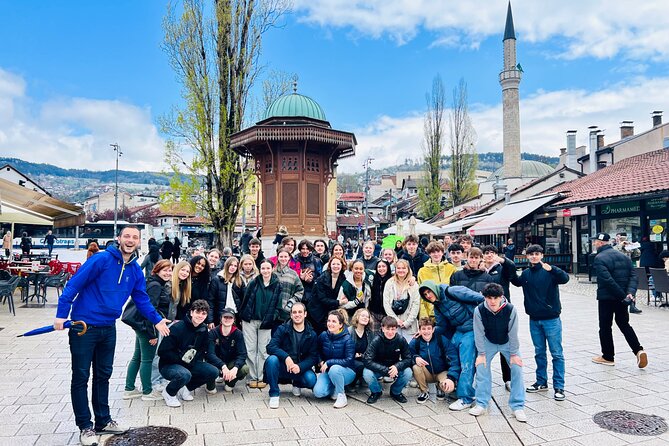
- Small group feel with a maximum of 10 travelers, keeping it easier to hear and ask questions
- English guide Mak makes the timeline feel understandable, not like a list of dates
- Ticket-free sights at every major stop, so you’re paying mainly for the guided context
- A focused 6:15 pm start that’s ideal for an evening city stroll without rushing all day
- War-era landmarks connected to WWI and WWII, taught right where the stories happened
Why this Sarajevo walking tour hits the right pace
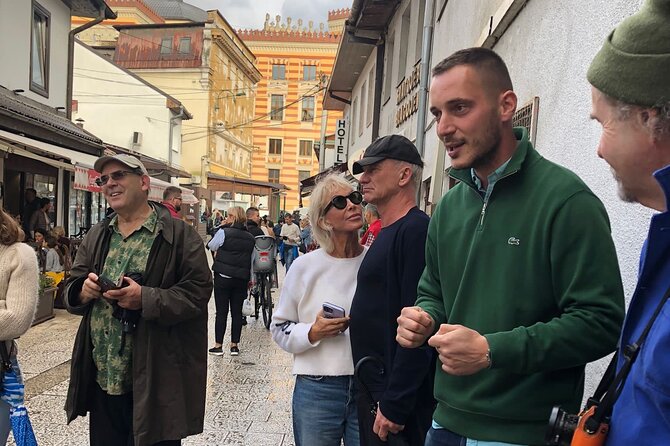
If Sarajevo is new to you, the hardest part is usually knowing where to start and what matters. This tour is built for that exact problem. In a couple of hours, you get a guided path through the most recognizable streets and landmarks, the kind you’ll keep seeing again on your own after the walk.
I also like that it’s not trying to do everything. It aims to do the main threads well: religious life, public spaces, and the heavy historical moments tied to WWI and WWII. That focus matters because Sarajevo’s story can feel complicated if you’re sorting it out alone.
And yes, it’s walking. Comfortable shoes help. But the route is paced to keep the group moving while still allowing short stops for photos and explanations.
You can also read our reviews of more walking tours in Sarajevo
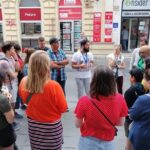
Meeting at Đulagina 2 at 6:15 pm: practical logistics that reduce stress
You meet at Đulagina 2, Sarajevo 71000 and the tour ends back at the same meeting point. That alone is worth something: after two or three hours, you’re not trying to retrace your steps across unfamiliar streets.
The start time is 6:15 pm, so you’re doing the walk in the evening. That can be a sweet spot for many travelers because it often avoids the harshest midday heat, and it also lets you see the city in a calmer light. (Just dress for the weather; the tour operates in all conditions.)
The tour also uses a mobile ticket, and you should receive confirmation at booking time. Service animals are allowed, and the dress code is smart casual, which is broad enough that you won’t feel overdressed.
Stop-by-stop: Sarajevo’s famous landmarks, in the order that makes sense
This walk is set up as a sequence of places that help you build a mental map quickly. The guide’s job is to connect each stop to the larger story, so you understand why the site is where it is and why people remember it.
Sacred Heart of Jesus Cathedral and the Roses of Sarajevo trail
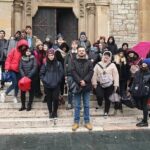
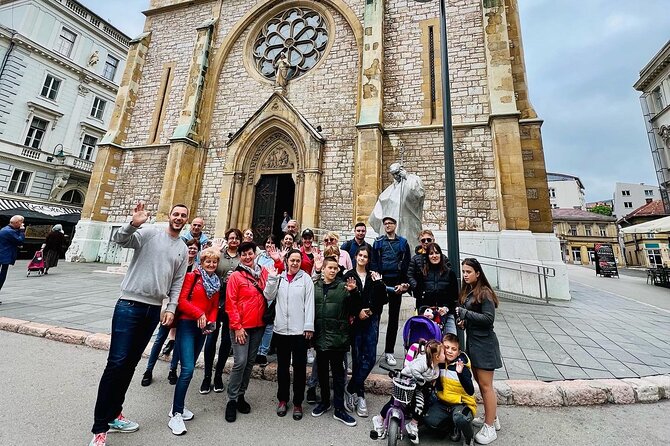
You begin at the Sacred Heart of Jesus Cathedral. Right from the start, Sarajevo signals it’s not one single culture—it’s many, overlapping across time.
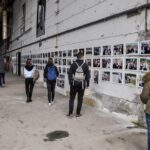
From there, you’ll encounter the Roses of Sarajevo concept, with a chance to see one of the rose markers right away. These small details are clever because they turn the city into a kind of open-air memory board. It’s an easy way to spot Sarajevo’s identity even before you’ve fully grasped the history behind it.
The tour listing shows admission as free for this stop, so you’re not waiting on ticket lines. It’s mostly listening, looking, and getting oriented.
Serbian Orthodox Church of the Nativity of the Theotokos, plus park time and a sculpture
Next comes the Serbian Orthodox Church of the Nativity of the Theotokos. This is where faith becomes visible in architecture and in the way the neighborhood is organized around it.
The stop also includes mention of the Mondo sculpture and a city park pause. That combination is smart: it breaks up the more formal “landmark” feeling and gives you a short reset before the next stretch.
This stop is also listed as free admission, which helps keep the experience moving and keeps the focus on the guide’s storytelling.
- Fall of Yugoslavia, Sarajevo War Tour with Tunnel of Hope Museum and Frontlines
★ 5.0 · 1,314 reviews

Ferhadija Pedestrian Street: the Eternal Flame and Tito street
On Ferhadija Pedestrian Street, you’ll hear about the Eternal Flame and Tito Street. This is the kind of central, recognizable street where history shows up in signage, monuments, and street-level storytelling.
You’ll also see the First Rose of Sarajevo mentioned in the route. I like this kind of repeated motif across the walk because it helps your brain file things in order instead of treating every site as a separate fact.
Again, the tour listing marks this as ticket-free, so you’re not juggling entrances while trying to follow the narrative.
Gazi Husrev-Beg Medresa: mosque, bazaar lanes, a clock tower, and Jewel street
At Gazi Husrev-Begova Medresa, you’ll get a concentrated look at Sarajevo’s older urban fabric. You’ll pass the Gazi Husrev-Beg mosque, plus the Bezistan Bazaar, the Clock Tower, and Jewel street.
Even if you’re not shopping, bazaar lanes are useful on a walking tour. They help you understand how people historically moved, gathered, and traded in the city’s center. A clock tower also acts like a visual anchor. It gives you an easy landmark to remember, which makes the rest of the walk feel more connected.
This stop is listed for about 20 minutes and marked as free admission, so it fits the tour’s rhythm without dragging.
Princip Gavrilo, Latin Bridge, and the WWI story that’s tied to the street
The walk turns heavier here, and the route is deliberate. You see places linked to major events, and the guide ties those moments back to the city’s public spaces.
Mausoleum of Princip Gavrilo and the assassination spot area
You’ll stop at the Mausoleum of Princip Gavrilo, with the route also referencing the Latin Bridge and the assassination spot. If you only know Sarajevo from headlines, this is where you start making sense of why the city has such a strong historical footprint in European memory.
A good guide matters most in moments like this. Mak’s style, based on what I saw in the structure of how the tour is described, is to keep the story clear and connected rather than leaving you with a list of names.
This stop is listed as free admission, so it’s a listening-first stop.
Latin Bridge: Franz Ferdinand and Sophie, WWI
Then you move to Latin Bridge, with the route specifically calling out the assassination of Franz Ferdinand and his wife Sophie and tying it to WWI.
This is one of those places where understanding comes from standing where the event happened. You’re not just learning a date; you’re learning how that moment became part of Sarajevo’s geography and identity.
The tour indicates free admission for this stop as well, so you can focus on the guide’s explanation and the overall timeline rather than worrying about entry procedures.
City Hall, Inat Kuća, fortresses, and the Olympic mountain viewpoints
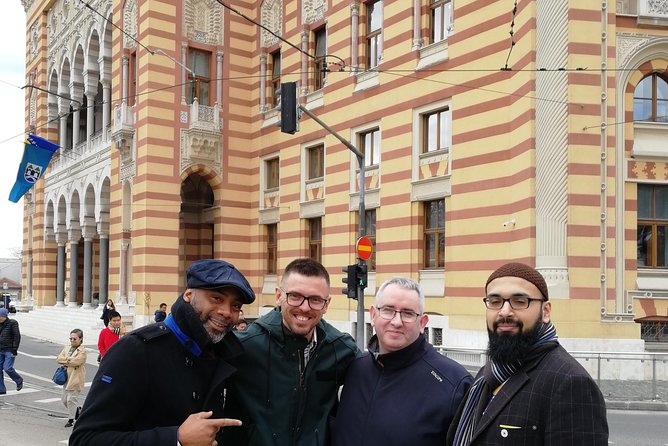
After the WWI segment, the route shifts again. It pulls you into civic Sarajevo: the places tied to government, public life, and local landmarks that keep showing up in the city’s image.
Sarajevo City Hall and what’s around it
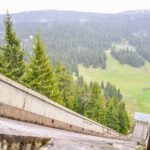
At Sarajevo City Hall, you’ll see or pass by Inat Kuca, White Fortress, Yellow Fortress, Jajce Army house, and the mention of 1984 Olympic mountain.
This is a lot for one stop, but that’s the point: you get a quick “map of importance.” I like that the route includes fortresses and named structures because it helps you recognize them later when you’re wandering on your own.
The stop is listed for about 20 minutes and marked as free admission. That’s a manageable chunk, not a forever-wait.
Yellow Fortress and Kovaci street plus Food street
From there you head to the Yellow Fortress area, along with Kovaci street and Food street.
Even if you’re not planning to eat right then, this is a helpful moment to orient yourself toward where people go day to day. Food streets are often the easiest way to find your way back to a lively area later without needing a bus map.
This stop is listed as free admission too, and around 15 minutes—just enough time to take it in.
Sebilj Brunnen and Pigeon Square: Sarajevo’s central public-life stop
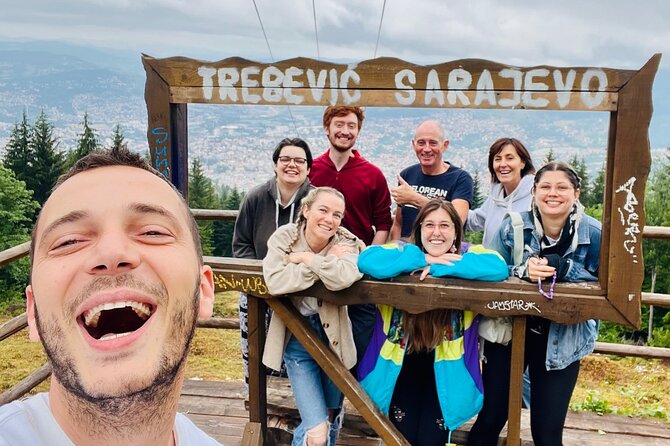
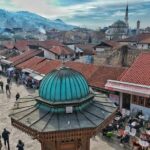
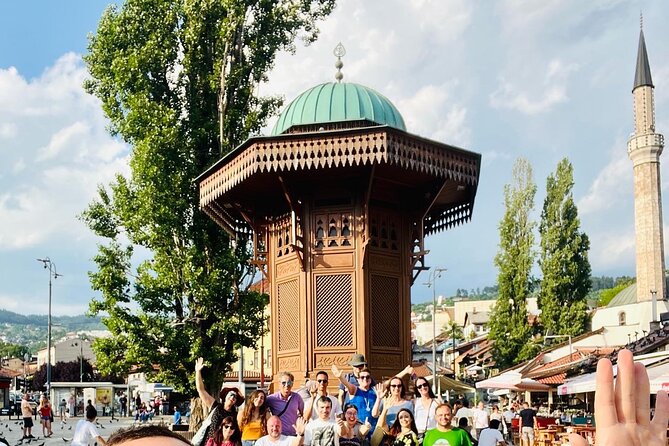
Next up is Sebilj Brunnen (Fountain), including Sebilj, Kazandziluk street, and Pigeon Square.
This part of the walk is great if you like “how people actually use a place.” Fountains and squares tend to be social anchors, and you’ll feel that quickly just by standing there for a few minutes.
Also, the tour again lists free admission, which makes this a smoother experience. You’re not doing museum logistics; you’re letting the guide place the site in context, then letting you absorb the vibe at street level.
Markale and the Jewish Museum: remembering the city’s tragedies and communities
The tour doesn’t shy away from the harder parts of Sarajevo’s modern history. But it handles them in a way that stays tied to where you’re standing.
Pijaca Markale: Yellow market, the Largest Rose, and a massacre spot
At Pijaca Markale (also described as the Yellow market), you’ll see the Largest Rose of Sarajevo mentioned in the route. You’ll also hear it connected to a Massacre spot.
This stop is emotional by nature. I like that the tour doesn’t treat it like a generic “nice square.” It’s framed as a place of remembrance, which matters if you care about understanding more than just taking photos.
The tour listing keeps this ticket-free, with about 15 minutes allocated.
Jewish Museum of Bosnia and Herzegovina: Jewish Park and the Sefardi synagogue
After Markale, the route takes you to the Jewish Museum of Bosnia and Herzegovina area, including Jewish Park and the Sefardi synagogue.
Even in a short walking tour, this is a meaningful inclusion because it reminds you Sarajevo has more than one story running through its streets. It’s one more layer in the city’s identity, presented right in the spaces where that community’s presence is part of the urban fabric.
This stop is listed with free admission and around 15 minutes.
Ending at the Eternal Flame: tying WWII liberation to the same landmark

To finish, you return to the Eternal Flame again, with the route explicitly describing it as the Fascist liberation of Sarajevo spot tied to WWII.
It’s a smart final move because you’re not just revisiting a place for convenience. You’re re-encountering the same landmark with a different historical lens, which helps the city feel less like disconnected points on a map.
The last stop is listed for about 5 minutes. That’s short, but it works as a clean “wrap the story” moment, and then the tour ends back at the meeting point.
Price and value: what $31.24 buys you in real terms
The price is $31.24 per person, and the tour runs 2 to 3 hours. At that cost, what you’re really paying for is the guide’s ability to connect the dots.
A big value signal here is that the itinerary lists free admission for the stops. So you’re not spending your limited time and money on entry fees. You’re paying mainly for a structured route and the explanations that make the route meaningful.
The small group size also improves the value. The overview talks about keeping costs down with a group tour of up to 15, while the details list a maximum of 10 travelers. Either way, it’s designed to be small enough that you’re not shouting to hear your guide.
For me, that’s the best kind of tour math: fewer entrance fees, more guided context, and a route you can repeat later as a self-guided loop.
How to get the most from Mak’s English-guided storytelling
You’ll get the most if you treat this as a guided orientation, not a museum replacement. Your goal is to leave with names, places, and the “why” behind the landmarks.
A couple of practical tips:
- Bring a notebook or use your phone notes. The guide will cover multiple eras fast, and writing down a few place names helps you recall them later.
- Wear shoes made for sidewalks. You’re doing a city walk with multiple short stops.
- If you’re traveling as a family, this route can work well because the guide checks understanding and adapts to the group’s needs.
Also, the tour is smart casual, and it runs in all weather. That means you should dress for rain or cold if the forecast calls for it. The tour isn’t built around one perfect day.
Who should book this Sarajevo walking tour
I’d point you to this tour if you want:
- A fast orientation to Sarajevo’s most famous landmarks
- Historical and cultural explanations tied to the places themselves
- A manageable evening start at 6:15 pm
- A route with mostly ticket-free stops
It’s especially good for people who hate wasting half a day trying to figure out directions and significance. If you like to understand a city before you wander, this kind of guided loop is a strong first step.
Should you book this Sarajevo walking tour?
If you have only a short time in Sarajevo and you want a clear, organized way to learn the city, I think this is an easy yes. The combination of small-group pacing, English storytelling from Mak, and a route packed with well-known sites makes it strong value for the time you spend.
Skip it only if you know you want to linger for long periods at fewer sites. This tour moves briskly through many stops, so it’s not designed for one-stop, sit-down sightseeing marathons.
FAQ
How long is the Professional Sarajevo Walking Tour?
It runs about 2 to 3 hours.
Is the tour offered in English?
Yes, it is offered in English.
Where does the tour meet?
The meeting point is Đulagina 2, Sarajevo 71000, Bosnia and Herzegovina.
What time does the tour start?
The start time is 6:15 pm.
How many people are in the group?
The tour lists a maximum of 10 travelers.
Are there admission tickets you have to pay during the tour?
The stops on the route are listed as admission ticket free.
Does the tour run in bad weather?
Yes, it operates in all weather conditions, so you should dress appropriately.
Is the tour suitable for families or children?
Children must be accompanied by an adult, and most travelers can participate.
Can I cancel and get a full refund?
Yes. Free cancellation is available if you cancel up to 24 hours in advance of the experience start time.
You Might Also Enjoy
More Walking Tours in Sarajevo


More Tours in Sarajevo
- Fall of Yugoslavia, Sarajevo War Tour with Tunnel of Hope Museum and Frontlines
★ 5.0 · 1,314 reviews

More Tour Reviews in Sarajevo
- Fall of Yugoslavia, Sarajevo War Tour with Tunnel of Hope Museum and Frontlines
★ 5.0 · 1,314 reviews